Introduction
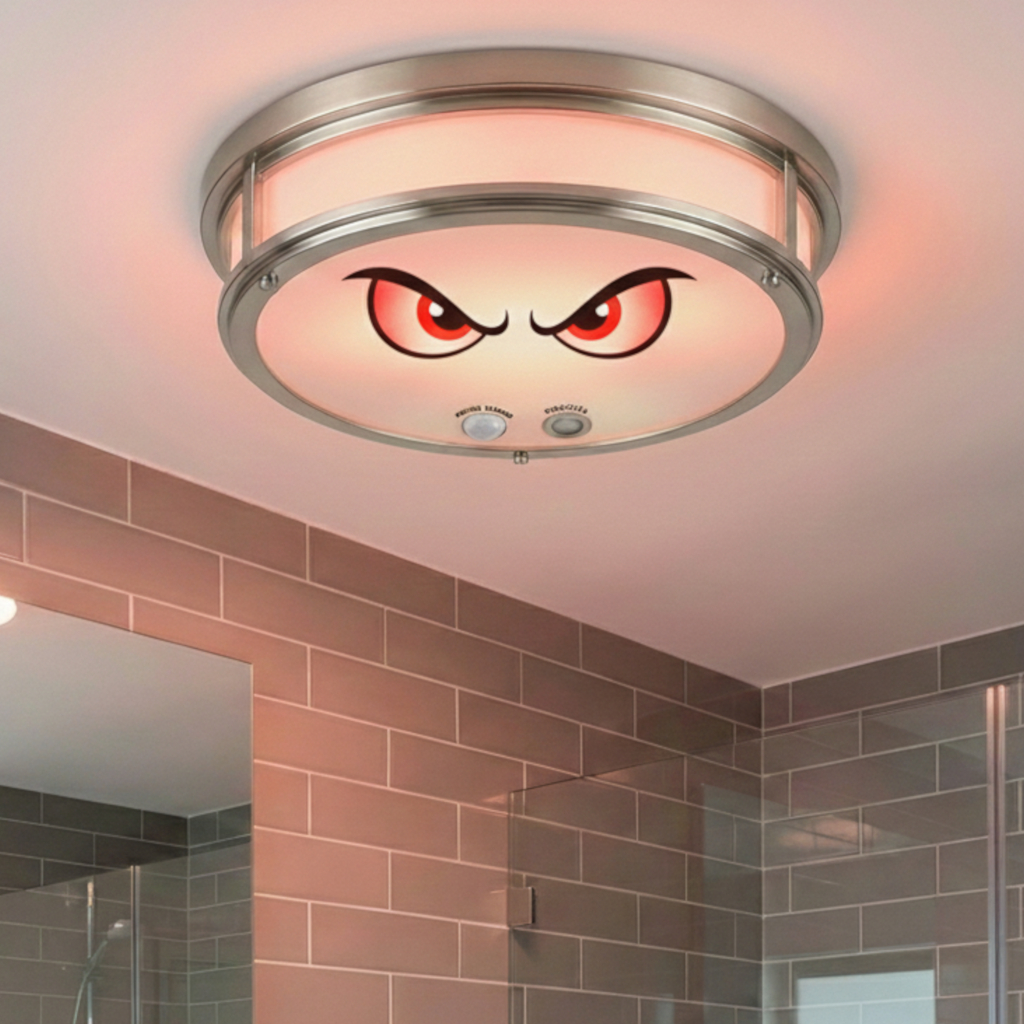
I usually don’t like to rant about anything, especially in public, but buying a (bathroom) lamp with light and motion sensor was a big mistake in hindsight. This is not about a specific product, but about the category of products in general. More specifically about products that are configured out of the box, that you just attach to a wall or ceiling and “should work”. So, the products I talk about do not have some rotary knob to adjust the sensitivity of when you think it’s dark enough to let the lamp respond to motion.
Situation
The lamp I bought was a model that replaced an old lamp that just worked with a regular on/off switch on the wall. So, it’s either on or off according to your wishes, plain and simple. The replacement lamp also responds to the same wall switch, with off meaning off entirely because it naturally won’t get power whatsoever. But at the same time, turning the wall switch to “on” means that the device now has the complete and ultimate power to decide your fate of receiving photons or not. Did it mock me? Constantly.
Don’t Buy for These Reasons
It might be a different case when you do have the power to decide the sensitivity of when the lamp should react, but when you do not have this, consider the following:
- If the light switch is turned off at first, and you turn it on, the lamp will be on for 10 seconds. It will go off again, to then decide if it will turn on based on the input readings of current luminosity and motion.
- This means that if you don’t like the bathroom light to turn on at all at night, while someone else for instance does, that person will always have this on/off/on experience when turning on the lamp with the switch.
- If you leave the light switch on, you and your lamp may now disagree whether it is bright enough in the room. It is almost never the case that it is bright enough, so oftentimes you are left alone in some sort of twilight.
- Because the lamp is probably designed to keep receiving power, it will also decide to turn itself off if it no longer detects motion. This means that sometimes it does not detect you being there and suddenly turns off about one to five minutes mid-shower.
- Sometimes you just need to grab something from the bathroom and there is sufficient light to see and grab it, but of course then the lamp decides you need all the light in the world.
In Short
- Inconsistent activation
- False triggers
- Limited coverage
- May conflict with personal preferences
- Something simple and straightforward is made complex and unintuitive
Conclusion
To be honest, for me there is hardly a situation where this type of lamp comes in handy, unless maybe you have your hands full and are practically not able to turn the switch on. If you do have control over what range of motion should be detected, what quantity of light or lack thereof triggers it to go on, it might be a consideration to buy such a “smart” lamp. But even then, the disadvantages may outweigh the advantages. Because something else may trigger the lamp unintentionally, yourself included if you just need to grab a small item. It will turn the light on for minutes at a time with no-one around (anymore). More technology is not always better.